




Why native domains matter for comparison sites
A local domain per country reaches the right shoppers, ranks for local searches and adapts to each market. Why it beats one site translated fourteen times.

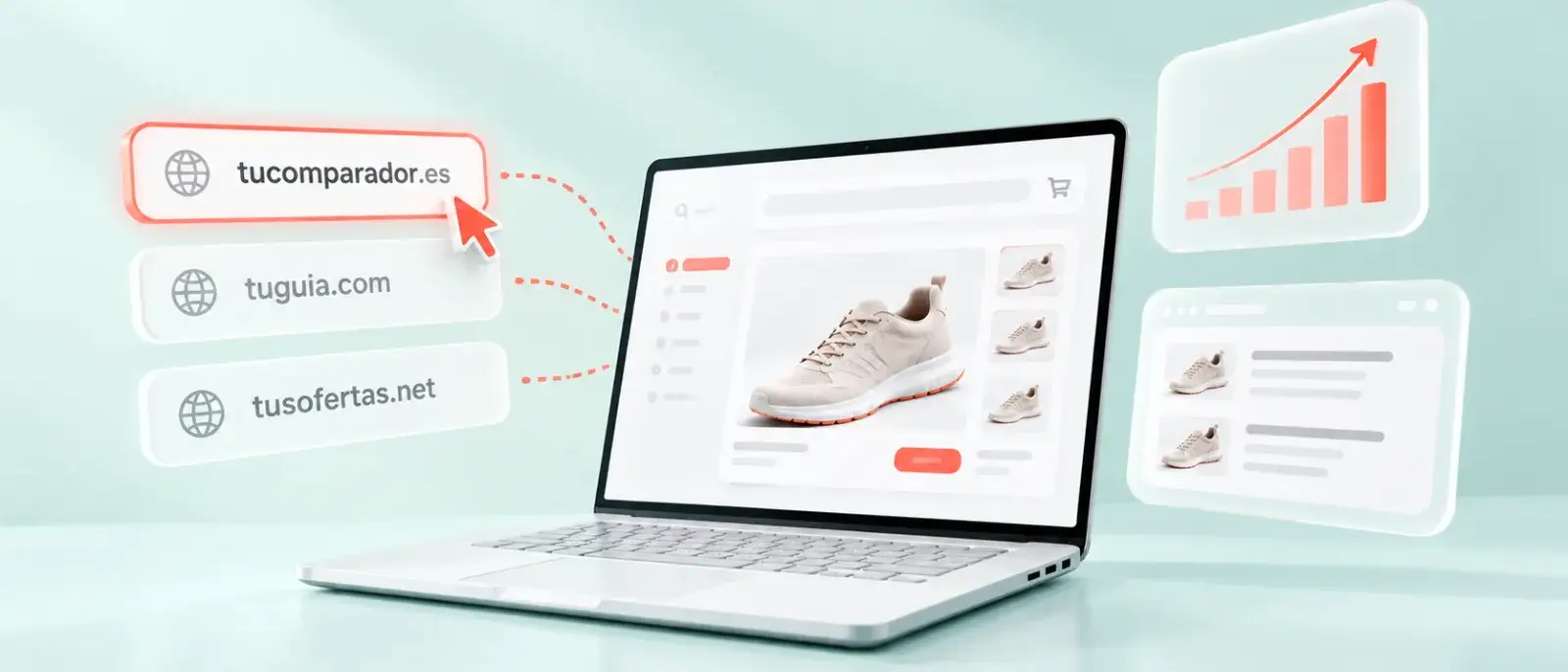
- Shoppers trust sites that look and read local.
- Country domains are one of the clearest signals to search engines about which market a site serves.
- Native sites can adapt categories, stores and language to each market.
Shoppers trust what feels local
A shopper in Madrid comparing headphones expects a Spanish site, with prices in euros, local delivery terms and stores they recognise. A translated page from another country often feels like exactly that: a translation. Native sites remove that friction before the first click.
- DEFINITION Native domain
- A site built for one country, on that country’s domain or language path, with local language, stores and conventions, rather than a translated copy of a central site.
Trust matters more on a comparison site than on most others, because the shopper is about to leave it for a store. If the comparison site itself feels foreign, the stores it recommends inherit that doubt.
Clear signals for search engines
Search engines need to know which market a page is for. A country domain is one of the clearest signals available. Combined with local language and local content, it helps the site rank for the searches shoppers in that country actually make.

| Option | Example | Market signal |
|---|---|---|
| Country domain | example.de | Strongest, tied to one country |
| Subdirectory | example.com/de/ | Clear, if set up with hreflang |
| Subdomain | de.example.com | Clear, if set up with hreflang |
| One translated site | example.com?lang=de | Weak |
Subdirectories and subdomains can work well when they are properly configured, with hreflang tags that tell search engines which version is for which country and language. A country domain makes that signal explicit, and shoppers see it in the address bar.
Each market searches differently
Translation gets the words right, but not always the searches. Shoppers in each country use their own terms, units and brand names.
| Market | Shoppers might search | Not |
|---|---|---|
| Spain | zapatillas running | calzado deportivo para correr |
| Germany | Laufschuhe Herren | Sportschuhe zum Laufen Männer |
| France | casque bluetooth | écouteurs sans fil arceau |
| Italy | cuffie wireless | auricolari senza fili ad arco |
A native site is built around those searches from the start: category names, filters and product titles follow the way people in that market actually shop.
Adapting to each market
Markets don’t just speak different languages. They shop different categories and use different stores. A native site can reflect that: the categories people browse in Germany are not the same as in Italy.

- Stores. Shoppers want to see the retailers they know, next to new ones.
- Delivery. Local delivery times and costs are part of the comparison.
- Formats. Prices like 1.299,00€ in Spain and Germany, or 1 299,00 € in France.
- Seasons. Local sales periods and holidays shape what is promoted and when.
What it means for merchants
For a merchant, being listed on a native comparison site means appearing in front of local shoppers, in their language, for the searches they make, without building that presence yourself in every market. Your feed does the work; the site handles the local layer.
Getting hreflang right
If you run several language or country versions, hreflang tags tell search engines which page to show to which shopper. Mistakes here are common and can send shoppers to the wrong market.
- Every version must point to every other version, including itself.
- Use the right codes: es-ES for Spain, de-AT for Austria, fr-BE for French-speaking Belgium.
- Add an x-default page for shoppers outside your target markets.
- Keep hreflang consistent with canonical tags.
Local trust signals
| Signal | What shoppers expect |
|---|---|
| Currency and format | Local currency, with local decimal and thousand separators |
| Prices | VAT included, as required for consumer prices in the EU |
| Delivery | Delivery times and costs for their country |
| Language | Native copy, not machine translation |
| Legal pages | Terms, privacy and returns in the local language |
One catalogue, many markets
The same product can look quite different in each market once it is localised properly.
| Market | Listing title | Price shown |
|---|---|---|
| Spain | Auriculares inalámbricos Sono Q5 con cancelación de ruido | 129,00 € |
| Germany | Sono Q5 kabellose Kopfhörer mit Geräuschunterdrückung | 129,00 € |
| France | Casque sans fil Sono Q5 à réduction de bruit | 129,00 € |
| Poland | Słuchawki bezprzewodowe Sono Q5 z redukcją szumów | 549,00 zł |
Comparison site or marketplace?
Both put your products in front of shoppers who are comparing, but they work very differently.
| Marketplace | Comparison site | |
|---|---|---|
| Where the shopper buys | On the marketplace | In your own store |
| Customer relationship | Owned by the marketplace | Stays with you |
| Your brand and checkout | Limited | Fully yours |
| Typical cost | Commission on every sale, plus fees | Per click or per validated sale |
A comparison site sends the shopper to your store, so the customer, the data and the repeat purchases stay with you.
Measuring each market
- Track sales and conversion rate by market, not just in total.
- Compare average order value across markets to spot pricing gaps.
- Watch return rates by market: high returns can point to sizing or translation issues.
Fourteen markets need fourteen sites, not one site in fourteen languages.
Quick answers
Do I need a local entity to be listed?
No. You need a store that ships to that market and a product feed.
Will my products be translated?
Your listings use the data in your feed for each market, so a local-language feed works best.
Which markets does Komparoo cover?
Fourteen European markets, each with its own native comparison site.
Is a country domain always better?
Not always. Well-configured subdirectories can rank too. But a country domain is the clearest signal for shoppers and search engines.
Can I list only some products per market?
Yes. You can choose which products and markets to include.
Get the next shift in European e-commerce before it hits your numbers.
One email a month on Google Shopping, comparison sites and AI search. No spam.
Controller: Komparoo. Purpose: sending our newsletter. You can unsubscribe or exercise your rights at any time. More in our privacy policy.
Sources: Google Search Central (international and multilingual sites), Google Search Central (localized versions and hreflang), EU Price Indication Directive (98/6/EC), Komparoo.